
Warner Bros. Pictures
Why do dinosaurs continue to fascinate us? For one thing, these creatures are as close as mythology gets to reality. Unlike dragons, fairies, or even Bigfoot, there’s abundant verifiable scientific proof that these warm-blooded reptiles actually existed. As such, an adventure or horror story involving dinosaurs feels that much more plausible, all while the mysteries surrounding how they actually looked, behaved, and so on makes them even more beguiling than, say, a tiger or a bear. In addition to all of that, the dinosaur is, in historical terms, a tragic creature. Instead of a species driven out of existence by natural selection, their extinction feels almost cosmically mandated. Every living thing must face entropy at some point, just as every era has an ending, yet it still feels like the dinosaurs were especially doomed.
“The End of Oak Street,” the latest film from writer/director David Robert Mitchell, is a movie that, beneath its surface, is largely about this theme of existential finality. It just so happens that Mitchell has wrapped this melancholy, slightly bitter pill inside a delicious confection which closely resembles the early work of Steven Spielberg, both as a director and as a producer. With the films he’d produce under his Amblin Entertainment banner during the 1980s, Spielberg delivered crowd-pleasing genre romps which nonetheless contained some sharp edges. His own “Indiana Jones and the Temple of Doom” as well as Joe Dante’s “Gremlins” infamously pushed the boundaries of the rating system at the time. “The End of Oak Street” expertly recalls this style of genre filmmaking, right down to its score, choice of lenses, and more. Yet it isn’t mere throwback or homage. Instead, Mitchell has made a highly personal movie that resonates with its depth as much as it delights with its action and visual effects.
In The End of Oak Street, the spectacle is there to serve the characters

Warner Bros. Pictures
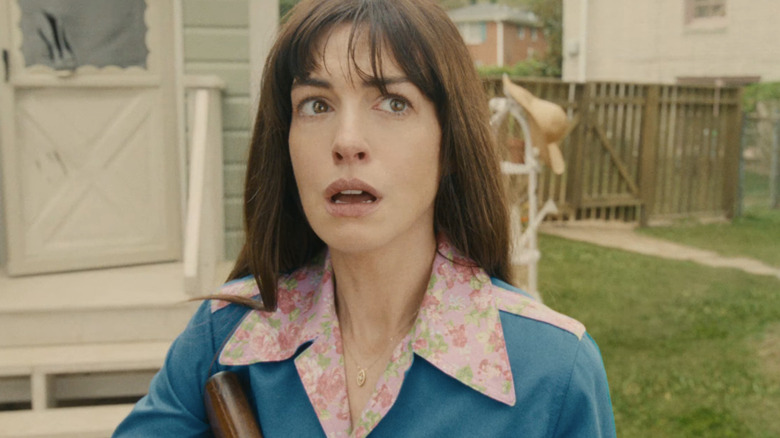
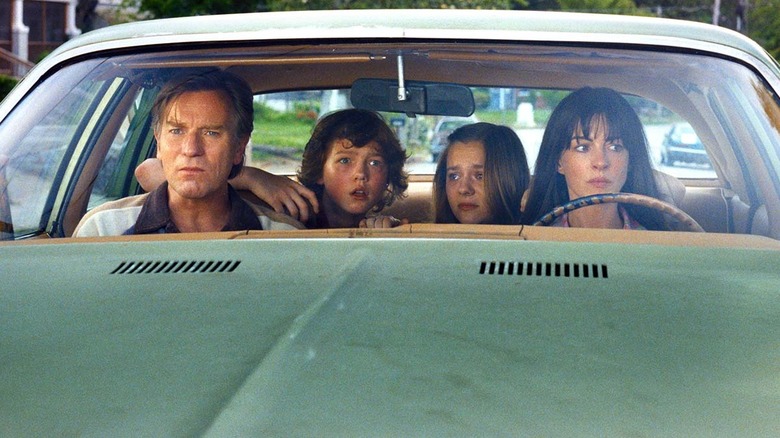
“The End of Oak Street” has a deceptively simple premise, one that might seem to imply a lack of depth in the film. Set in a quiet suburban town in Michigan in 1982, the film follows the Platt family as they live what seems from afar like a quaint, idyllic existence. Unfortunately, all is not well in their household: Denise (Anne Hathaway) is a frustrated aspiring author feeling constrained by being a housewife. Greg (Ewan McGregor) avoids as much conflict and responsibility as he can by hiding in his making-ends-meet pizza delivery gig. Audrey (Maisy Stella) feels ostracized by her peers as she yearns to follow her dream of studying astronomy, while Brian (Christian Convery) is lashing out at neighborhood bullies and spending the bulk of his time with the family dog, Starbuck. On top of all that, Denise and Greg seem to be on the brink of divorce, something which Audrey and Brian are all too aware of.
Such issues take a backseat (though don’t completely disappear) on the night when the Platt’s neighborhood is mysteriously transported back in time to a prehistoric era. From there, the family are forced to survive while surrounded by a plethora of curious, hungry, and agitated dinosaurs, their home instantly transforming from a refuge into a target. In a lesser film, this would mean that the Platts would be constantly on the move from one harrowing encounter to the next, yet David Robert Mitchell never allows the spectacle to overtake the characters. Instead, “The End of Oak Street” remains remarkably grounded in the way the Platts deal with their predicament both physically and psychologically.
The End of Oak Street indulges in homage while remaining credible

Warner Bros. Pictures
As I said earlier, the entirety of “The End of Oak Street” doubles as a homage to the films of Steven Spielberg, whether he was in the director’s chair or not. The film features a handful of attention-grabbing split diopter shots (composed in a manner similar to how Spielberg utilized them in “Jaws”), as well as set decoration soaked in the pop-culture of the era (which recalls Tobe Hooper’s “Poltergeist”) and dino mayhem happening in the margins of several sequences (a technique that brings to mind Joe Dante’s “Gremlins” as well as Spielberg’s first “Jurassic Park”). In this fashion, it’s also highly reminiscent of a film directed by “Oak Street” producer J. J. Abrams, 2011’s “Super 8.” Both Abrams’ movie and David Robert Mitchell’s insightfully resurrect the period setting as well as the general tone of late ’70s/early ’80s genre films. In the case of “Oak Street,” that tone includes the boundary-pushing nature of that period, for although the movie is rated PG-13, Mitchell doesn’t hold back from bringing his experience with horror and harder-edged material to bear.
In this way, “The End of Oak Street” isn’t an instance of an independent filmmaker being thrust into a big budget blockbuster, á la Colin Trevorrow’s “Jurassic World.” Mitchell has a clear, inherent understanding of how bringing personal touches to material like this can help make it come to life. This doesn’t mean he zigs where every other genre movie would zag, but instead knows that movies like this can fail if the characters are bland and unrelatable, as well as if the action is too unbelievable. Despite the presence of sudden wormholes in time and dinosaurs, there’s a credibility and humanity to the movie throughout.
The End of Oak Street is thoroughly a David Robert Mitchell movie

Warner Bros. Pictures
In fact, “The End of Oak Street” is not David Robert Mitchell taking a wholesale detour into blockbuster filmmaking or period homage. It’s thoroughly a Mitchell movie: it’s shot by Mitchell’s regular cinematographer, Michael Gioulakis, and is set in suburban Detroit, where “The Myth of the American Sleepover” and “It Follows” also took place. Its mercurial tone, where the film can move from lighthearted to upsetting at the drop of a hat, recalls the playfulness of “Under the Silver Lake.” In a big way, “Oak Street” continues Mitchell’s interest in juxtaposing the familiar with the threatening. Similar to how the murderous entity in “It Follows” takes the form of ordinary people and how the conspiracy in “Under the Silver Lake” is hidden under the noses of most Angelenos, Mitchell and Gioulakis make sure we never lose sight of killer dinosaurs invading what was once a placid suburban space.
Mitchell’s films all concern characters who exist in some form or state of nostalgia, only to find themselves faced with a loss of innocence either figurative or literal. In this, “The End of Oak Street” is no exception. Yet while “It Follows” and “Under the Silver Lake” could be read as critiquing its protagonists for being too ignorant of the darkness of the outside world, “Oak Street” is much kinder toward the Platts. Like the dinosaurs not knowing about a meteor before it hit, the film functions more like a disaster movie than horror. The outside world is full of danger, and one can’t avoid it forever.
The End of Oak Street feels like the next part of a conversation about loss that the films of 2026 are having
Warner Bros. Pictures
As /Film’s own Chris Evangelista observed in his review of “The Odyssey,” the genre films of 2026 appear to be engaged in a bigger cultural conversation. Steven Spielberg himself returned to the summer movie season this past June with “Disclosure Day,” a film which wondered if as seismic an event as worldwide first contact with extraterrestrials might rekindle our capacity for empathy and understanding. Christopher Nolan’s “The Odyssey” went as far back as the Trojan Horse incident as an original sin moment for humanity’s loss of trust in one another. In this vein, “The End of Oak Street” sees its average American family encountering the potential total loss of civilization as they knew it, finding themselves thrust suddenly into a savage era. The movie is dedicated to David Robert Mitchell’s recently deceased father, and it’s easy to see how the film is coded in the melancholy of that loss. Having lost my own father this year (who, once upon a time, took me to see “Jurassic Park” on its opening weekend), this resonance felt especially strong.
Yet “The End of Oak Street,” despite its cheeky, ominous title, isn’t a movie that wallows in grief. Whether it’s the personal loss of a parent or the shared loss of a pre-pandemic America, Mitchell seems to be acknowledging the sadness of those events while being optimistic that we can find our way out of them. If nothing else, that’s where the power of cinema, particularly genre cinema, can come through. If even one of the Platts, totally unprepared as they were, can survive being eaten by dinosaurs, perhaps there’s hope for us to avoid becoming the dinosaurs, too.
/Film Rating: 10 out of 10
“The End of Oak Street” opens in theaters on August 14, 2026.

Upgrade Your Movie Nights with Fire TV Stick 4K Plus
Stream movies, shows and entertainment in 4K with an easy upgrade for your TV.
View on Amazon