Sunset Boulevard/Getty Images
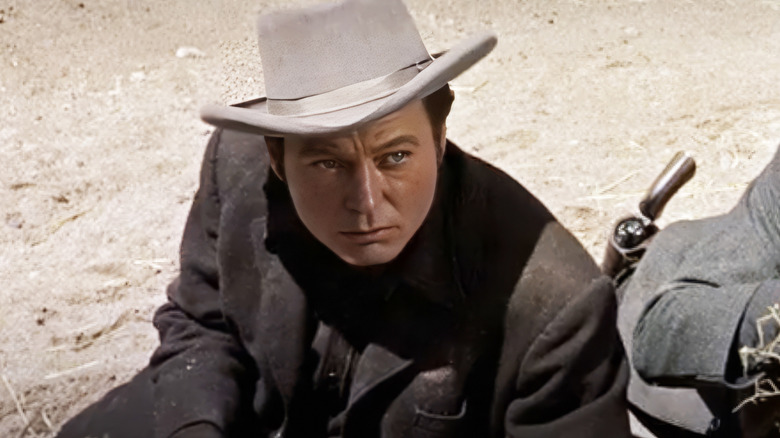
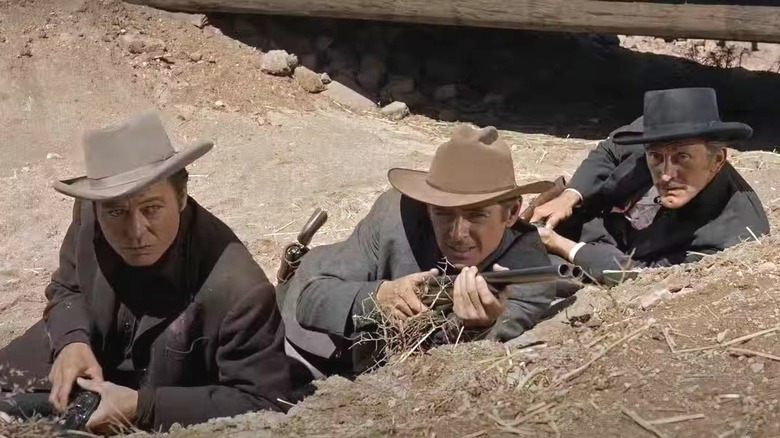
In 1957, future “Star Trek” actor DeForest Kelley played the minor role of Morgan Earp in John Sturges’ Western classic “Gunfight at the O.K. Corral.” It was a star-studded affair, with Burt Lancaster playing Wyatt Earp and Kirk Douglas playing Doc Holliday. It’s very much worth watching. If you keep your eyes peeled, you might also recognize a young Dennis Hopper as Billy Clanton and Lee Van Cleef as a character named Ed Bailey.
Prior to his stint playing Dr. McCoy on “Star Trek” in 1966, Kelley was a well-established and quite prolific Western performer. One of his very first TV roles was in an episode of “The Lone Ranger,” and one can find many, many oaters across his résumé. He was on “Gunsmoke,” “Dick Powell’s Zane Grey Theater,” “The Adventures of Jim Bowie,” “Boots and Saddles,” “Have Gun — Will Travel,” “Rawhide,” “Bonanza,” “The Virginian,” and a heaping fistful more. His Western output was far greater than the sci-fi he made.
And “Gunfight at the O.K. Corral” may be the highest-profile feature film Kelley ever starred in — at least that didn’t have the words “Star Trek” in the title. It was a $2 million production, and made (with re-releases) $10.7 million at the box office. Adjusted for inflation, that’s like a $24 million film making over $128 million. That’s a success in any era. “Gunfight” was also nominated for two Oscars, for its editing and for its sound recording, and it was generally liked by critics. The movie has a pretty glowing, long-lasting reputation, and it’s entirely possible that “Gunfight at the O.K. Corral” is currently being watched by your grandfather at this very moment.
The Gunfight at the O.K. Corral is a highly fictionalized version of history
Paramount
The real gunfight at the O.K. Corral took place on October 26, 1881, in the town of Tombstone, Arizona, and was fought between the local lawmen and a group of devious cattle rustlers. The gunfighters have all gone down in history as semi-mythic figures, and the events of the gunfight have been adapted multiple times into films and TV shows. Prior to “Gunfight at the O.K. Corral,” audiences had already been treated to films like “Law & Order” (1936), “Tombstone, the Town Too Tough to Die” (1942), and John Ford’s “My Darling Clementine” (1946) with Henry Fonda as Wyatt Earp. Also, from 1955 to 1961, ABC put out a TV series called “The Life and Legend of Wyatt Earp,” so the O.K. Corral was already an oft-revisited media well by 1957.
The screenplay for “The Gunfight at the O.K. Corral,” credited to Leon Uris, was actually “suggested by” a 1954 article in Holiday Magazine called simply “The Killer.” Both the article and the movie are not entirely accurate to history, but they make for an exciting story regardless. The bulk of the movie focuses on the relationship between Wyatt Earp and Doc Holliday, with the former being a stalwart lawman and the latter being a knife-throwing loose cannon.
There are many fascinating stories from the set of “Gunfight,” including the fun anecdote about how Douglas and Lancaster cost the film a day of shooting because they couldn’t stop laughing. Less fun is the story of how Jo Van Fleet, in order to better get into character, asked Kirk Douglas to slap her before a scene began.
Gunfight at the O.K. Corral was generally well-liked by critics at the time
Paramount
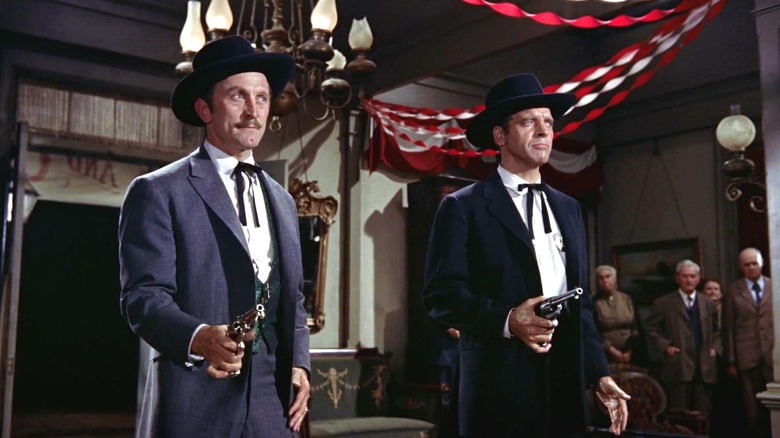
There is a moment in “Gunfight at the O.K. Corral” where Holliday refuses to help Wyatt Earp, as he’s still holding a grudge against Wyatt’s brother, Morgan. DeForest Kelley plays Morgan. Later in the movie, after Wyatt and Holliday have agreed to work together, it’s Morgan who scolds Wyatt for associating with such a rascal.
Critics were generally positive about “Gunfight at the O.K. Corral” when it was released. Writing for The New York Times, Bosley Crowther said that the performances were good and “rugged,” although he objected to the film’s love story subplots. There were, in his words, “odd, embarrassing moments when Cupid lets fly with his arrows.” Crowther also said he was put off by the film’s theme song, a ballad written by Dimitri Tiomkin with lyrics by Ned Washington and sung by Frankie Laine. Those three had previously written and performed the theme for “High Noon,” and Crowther said that the “Gunfight” theme was way too similar to the “High Noon” song. (He’s right. They are similar.)
Variety, as was its style at the time, was a little more terse in its brief review, complimenting the cast in the most general way. The review reads in part:
“Both stars are excellently cast in their respective characters. Rhonda Fleming is in briefly as a femme gambler whom Lancaster romances, beautifully effective, and Jo Van Fleet, as Holliday’s constant travelling companion again demonstrates her ability in dramatic characterization.”
There was no mention of DeForest Kelley in that review.

Upgrade Your Movie Nights with Fire TV Stick 4K Plus
Stream movies, shows and entertainment in 4K with an easy upgrade for your TV.
View on Amazon