United Artists
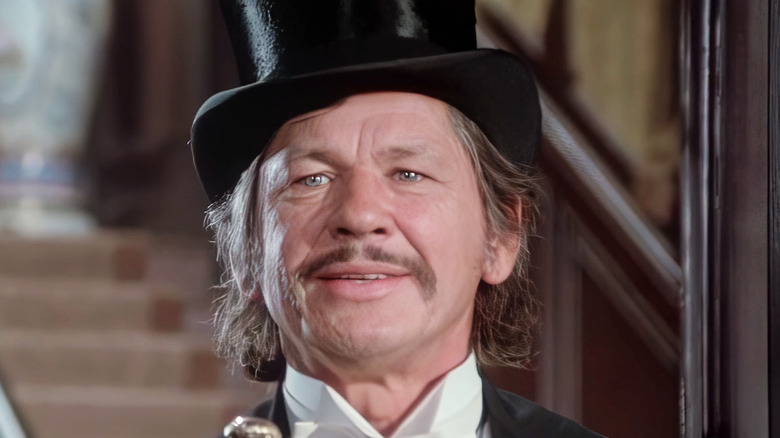
Charles Bronson’s Western career will always be somewhat defined by his roles as Harmonica in “Once Upon a Time in the West” and Bernardo O’Reilly in “The Magnificent Seven.” But the actor made several overlooked Westerns in the 1970s, many of which were much more offbeat than his legendary collaborations with Sergio Leone and John Sturges. Take the bizarre Bronson-led 1977 Western “The White Buffalo,” in which the actor embarks on a “Moby Dick” style odyssey punctuated by surreal dream sequences. Or how about the film he made the year prior, “From Noon till Three,” which sees Bronson and his real-life wife, Jill Ireland, play lovers in what might be the strangest, most tonally uneven Western Bronson ever made. Happily, it’s also quite good, and you can see for yourself over on Prime Video right now.
Like so many actors of his generation, Bronson appeared on classic Western TV shows, including “Gunsmoke” and “Bonanza.” Low-budget crime thriller “Machine-Gun Kelly” provided him with his breakout role in 1958, but he didn’t become the iconic screen presence we know him as today until after several high-profile roles in major features of the 1960s.
It began when he worked with “The Man from U.N.C.L.E.” star Robert Vaughn in “The Magnificent Seven.” That film also featured a young Steve McQueen, with whom Bronson collaborated again on his next biggest film project, 1963’s “The Great Escape.” Interestingly enough, by this point McQueen had bolstered his star status with a lead role in legendary Western series “Wanted: Dead or Alive,” which was one of several Oaters for which the polymathic Frank D. Gilroy had written. It was Gilroy who, more than a decade after “Wanted: Dead or Alive” came to an end, oversaw “From Noon till Three.”
From Noon till Three was an unusual movie starring an unusual Charles Bronson
United Artists
“From Noon till Three” started life as a 1973 novel by Frank D. Gilroy, who had a prolific career as a playwright, screenwriter, producer, and director. Gilroy won the Pulitzer Prize for Drama for his 1965 play “The Subject Was Roses,” but was also an accomplished big screen scenarist who penned a forgotten 1956 Western starring Leif Erickson and a rarely discussed silver screen legend. Gilroy had also written for beloved Western series including “The Rifleman” and the aforementioned Steve McQueen series “Wanted: Dead or Alive.” Somehow, he also found time to write “From Noon till Three,” which he then adapted for the big screen. The result was a strange mix of romantic comedy, revisionist Western, and straight up tragedy.
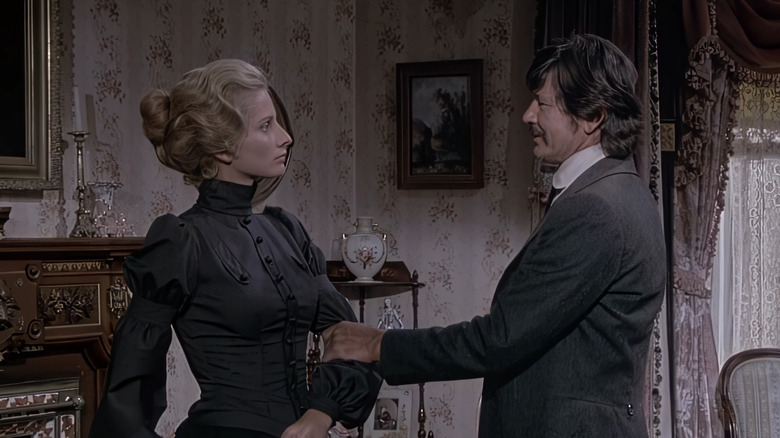
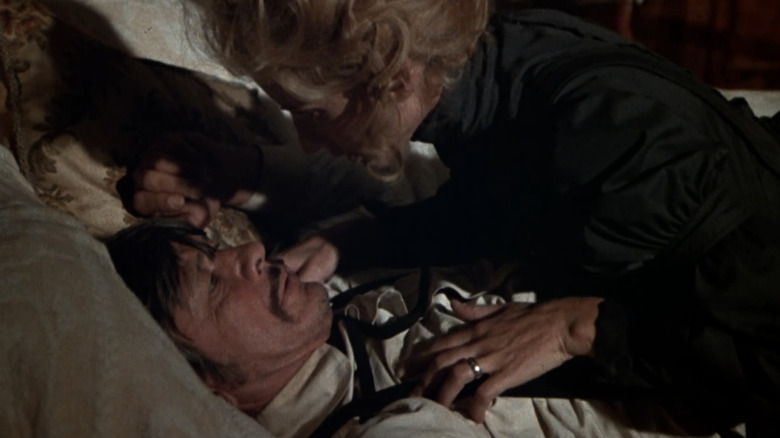
Even the trailer touted the film version of “From Noon till Three” as “an unusual movie starring an unusual Bronson.” Indeed, this was not the action anti-hero audiences had seen in “Death Wish” two years prior. In “From Noon till Three,” the actor plays outlaw Graham Dorsey, who decides to send his gang off to a bank robbery without him after having a dream in which the job goes south. Instead, he descends upon the home of Amanda Starbuck (Jill Ireland), forcing himself on the widow who quickly frustrates him by lying completely still. After Dorsey pretends to be impotent, he somehow wins her over and the two embark on an epic three-hour love affair (hence the film’s title) before Bronson’s outlaw leaves, ostensibly to rescue his crew. Instead, he rides in the opposite direction and forces a dentist to switch identities with him in order to evade a posse who recognize him. If this already sounds like a bewildering narrative mishmash, things only get more bizarre.
From Noon till Three is one of Charles Bronson’s most interesting Westerns
United Artists
In “From Noon till Three,” Amanda Starbuck presumes Charles Bronson’s Graham Dorsey is dead and begins turning their brief love affair into an Old West legend. Books are published, stage plays are put on, songs are written — all telling the story of a strapping outlaw and his widowed lover. Soon, an imprisoned Dorsey is released and returns to Amanda, only to find that his former lover doesn’t recognize him after having built up an entirely unrealistic image of him since his departure. The whole thing ends in tragedy, capping off a strange and often disorienting story that nonetheless is arguably one of Bronson’s best films.
One of the main things “From Noon till Three” has going for it is Bronson and Jill Ireland’s chemistry, which is undeniable — unsurprising given their off-screen relationship. But Frank D. Gilroy was also an old hand by the time he made the film, and his deconstruction of Western myth-making is also fascinating, even if it does seem like it belongs in an entirely separate movie to the romantic comedy in which Bronson and his wife fall in love.
Plenty of Letterboxd users certainly seem to like the film, which one called an “oddball hybrid of comedy, western and modern romance.” Meanwhile, the great Roger Ebert wasn’t quite as enthusiastic, but in his 2.5 star review he did note that the section in which Dorsey and Starbuck fall for one another “give[s] us new ideas about Bronson’s possibilities.” Regardless, “From Noon till Three” is one of the most unique Westerns to emerge from the late-’70s and is well worth a watch on Prime Video.

Upgrade Your Movie Nights with Fire TV Stick 4K Plus
Stream movies, shows and entertainment in 4K with an easy upgrade for your TV.
View on Amazon