Paramount
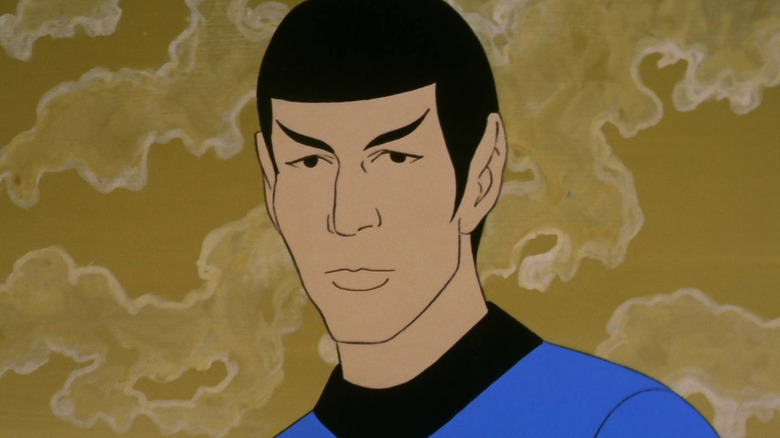
One of the best Spock-forward episodes of the “Star Trek” franchise, “Yesteryear,” is hidden deep in “Star Trek: The Animated Series.” The show ran for two seasons from 1973 to 1974, and it is, in some ways, superior to “Star Trek: The Original Series.” At the very least, because it’s a 30-minute program, it’s the more efficient show, having to tell similarly expansive sci-fi stories in half the time of “The Original Series.”
Case in point: “Yesteryear” sees Kirk (William Shatner) and Spock (Leonard Nimoy) conducting time travel experiments with the Guardian of Forever, a living, stone-like time portal previously seen in the franchise-changing “Original Series” episode “The City on the Edge of Forever.” After a sojourn to the past, though, something seems to have gone wrong with causality, and history has altered. No one can remember Spock, and an Andorian man has replaced him as the first officer of the USS Enterprise. This is a new, unfamiliar timeline.
Kirk and Spock look up the historical records in this new timeline and find that its version of Spock died at age seven back on Vulcan, poisoned by a catlike beast called a le-matya. Spock recalls, however, being saved from the le-matya by a cousin named Selek. Upon reflection, Kirk realizes that this mysterious Selek was likely Spock, having come from the future. The pair logically deduce that Spock needs to go back in time, pose as Selek, and save his seven-year-old self from a monster.
But the drama of “Yesteryear” delves deeper than a mere rescue mission. Indeed, the episode transforms into a thoughtful character piece about the decisions we make as children and the people we become as a result.
Yesteryear delves into Spock’s childhood
Paramount
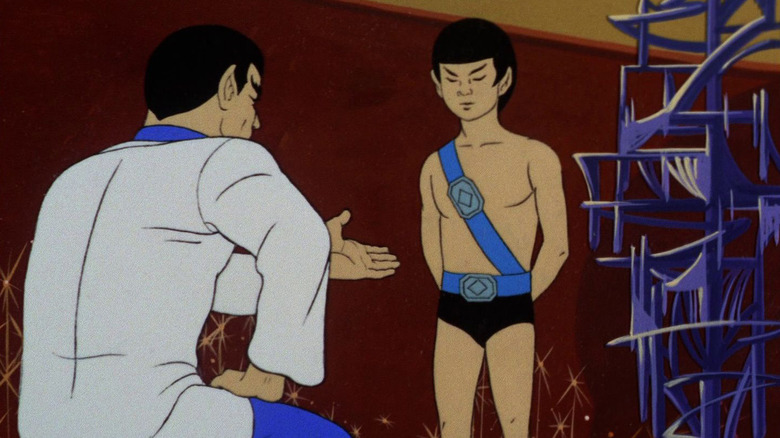
Spock, as you might recall, is half-human, and “Yesteryear” reveals that this was once a source of consternation for him. In fact, Spock was mocked and bullied as a child for his human blood, and he struggled between identifying as either human or Vulcan. He was once teetering on an important life question: will he choose the path of passionate human emotion or analytical Vulcan logic?
At age seven, the young Spock (Billy Simpson) is poised to undergo a coming-of-age ritual called the kahs-wan, a ritual that will prove his Vulcan-hood, yet he’s initially unsure if he is prepared. The adult Spock gets to be present for this, and while the character is not emotional, viewers will likely wince when they see young Spock being bullied. Adult Spock has already chosen the path of logic, of course, but we can imagine his inner pain. How would you react to witnessing your own childhood bullying? Recall that adult Spock, while facing this, is also on a mission to repair time and needs to ensure that his childhood self chooses a Vulcan path. For a spell, then, he gets to be his own adult guardian.
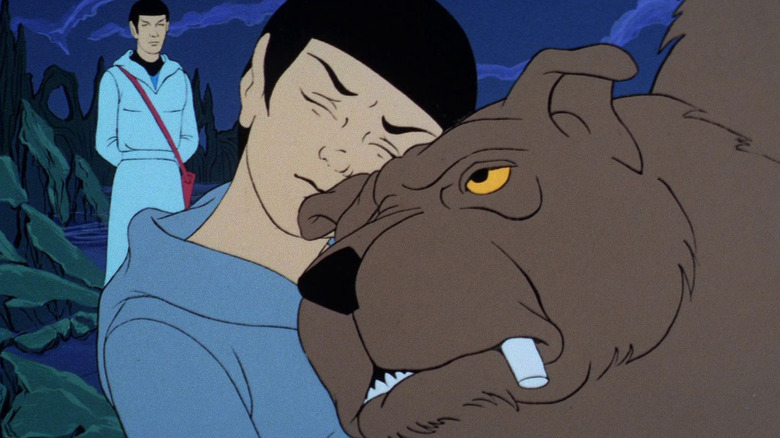
The tension of “Yesteryear” involves young Spock trekking into the desert to undergo the kahs-wan ritual a month ahead of time. He has something to prove, you see, and takes his beloved childhood pet, a bear-dog named I-Chaya, as he prepares to spend a prolonged period surviving in the desert wilderness. And while the young Spock struggles to defend himself from the local fauna, adult Spock is, luckily, nearby to protect him from a le-matya attack. Unfortunately, this leads to a very difficult decision for young Spock.
Spock makes a very difficult decision
Paramount
During the scuffle, I-Chaya, is injured by the le-matya. A healer is then brought in and informs young Spock that although he can heal I-Chaya, it would lead to a long life full of struggle and intense pain for them. The young Spock, although caring deeply for his pet, logically deduces that euthanizing him is the logical, merciful decision.
It’s this decision that leads Spock toward a life of logic. He chooses the path of being a Vulcan. It’s a hard-won decision, yet it allows Spock to become who he’s meant to be.
“Yesteryear” was penned by D.C. Fontana, who was involved with the “Star Trek” franchise on through to the early days of “Star Trek: Deep Space Nine” in the early 1990s. Fontana even went on record about how she corrected some issues with the “Next Generation” series bible, and she is best known to Trekkies for having written classic “Original Series” episodes like “This Side of Paradise,” “Journey to Babel,” and “The Enterprise Incident.” She also served as a story editor on “The Animated Series” and definitely had an ear for excellent sci-fi stories (having additionally contributed to the underrated Marvel animated series “Silver Surfer,” and written episodes of shows like “Earth: Final Conflict” and “ReBoot”).
“Yesteryear” explores Spock’s past better than any “Star Trek” episode before it, and it should be pored over by Trekkies everywhere. That it’s part of the woefully under-seen “Animated Series” means that it remains largely obscure to mainstream audiences. But it needn’t be, as it’s readily available to watch on Paramount+. For that matter, you should watch all of “The Animate Series.” Think of it as the final two years of the five-year mission from “The Original Series.”

Upgrade Your Movie Nights with Fire TV Stick 4K Plus
Stream movies, shows and entertainment in 4K with an easy upgrade for your TV.
View on Amazon