Paramount
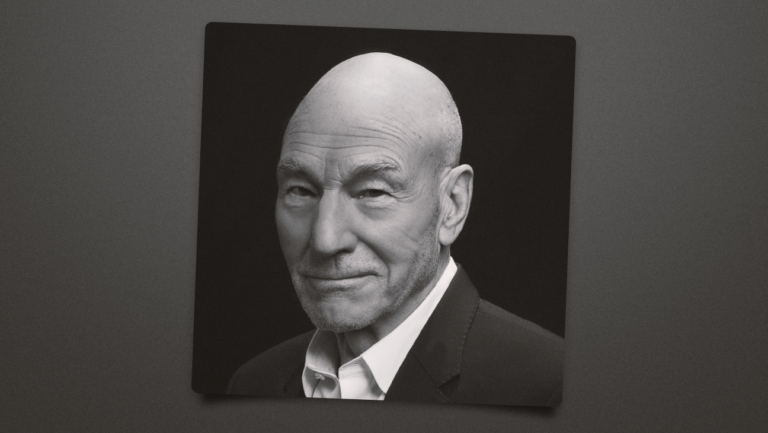
Classically trained Grammy and Olivier Award-winning actor Sir Patrick Stewart, a member of the Royal Shakespeare Company from 1966 to 1982, humanitarian, foster parent to pit bulls, and star of stage and screen, has died “following a brief and poignant journey with Alzheimer’s Disease and Lewy Body Dementia.” This was confirmed by his family courtesy of his official X account. He was 86 years old.
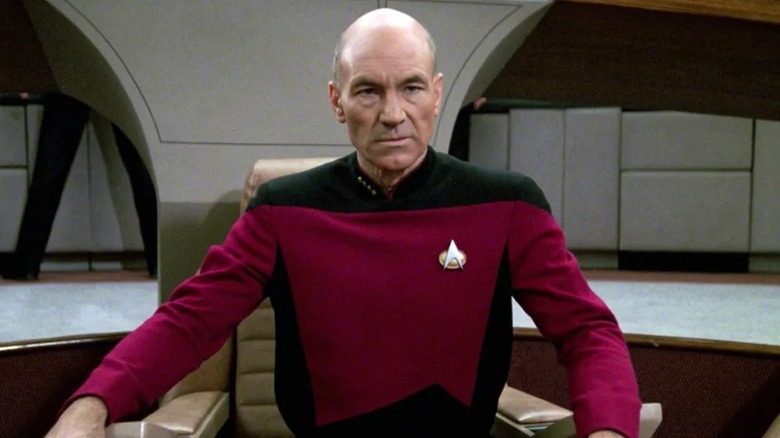
Stewart was perhaps best known for his role as Captain Jean-Luc Picard, the stalwart and stern commander of the starship Enterprise on the 1987 series “Star Trek: The Next Generation.” Stewart would play Picard for seven seasons of that show, and reprise the role for four feature films. In 2020, he would play Picard again in the three-season Paramount+ series “Star Trek: Picard.”
In feature films, Stewart was known the world over as Prof. Charles Xavier, the gentle psychic leader of the X-Men, a role he played in nine feature films beginning in 2000, and most recently in this year’s upcoming “Avengers: Doomsday.” Stewart’s first film role came in 1975, when he appeared in “Hedda,” a modernized version of Henrik Ibsen’s “Hedda Gabler.” He also played King Leondegrance in John Boorman’s 1981 film “Excalibur,” and the gruff soldier Gurney Halleck in David Lynch’s 1984 adaptation of “Dune.”
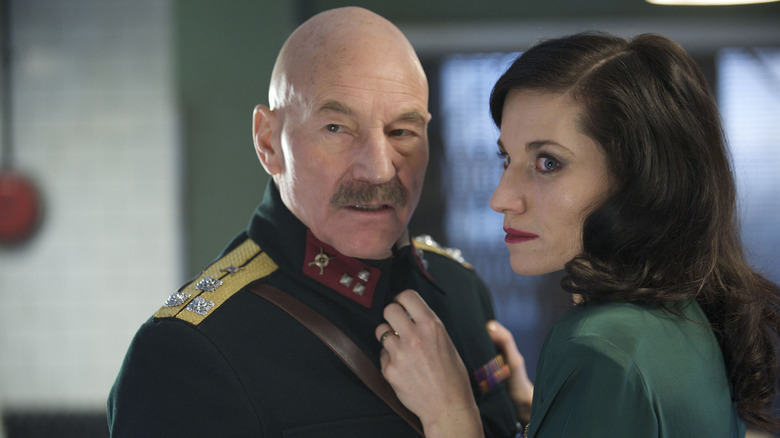
For the BBC, Stewart appeared in two Shakespeare productions in the 1970s and 1980s when the network produced a filmed series of the Bard’s complete works. In “Antony and Cleopatra,” Stewart played Enobarbus, and in “Hamlet,” he played Claudius opposite Derek Jacobi. He would play Claudius again in a 2009 BBC “Hamlet” opposite David Tennant. In that version, he also played the Ghost of Hamlet’s Father. In 1976, Stewart appeared as the Roman general Sejanus in the celebrated historical miniseries “I, Claudius.”
Sir Patrick Stewart on stage
BBC
Patrick Stewart began his acting career on the British stage. He once said in a BBC interview that when he was a child of 10, a teacher named Cecil Dormand put a copy of Shakespeare in his hand and demanded that he “get up on [his] feet and perform.” It was advice he took to heart. As a teenager, Stewart briefly worked a menial journalist job, but eventually found he would prefer to act instead, and became an actor full time.
Still only a teen, Stewart began appearing on stage at the Old Vic. In 1965, only 25, he appeared as Shylock in a production of “The Merchant of Venice.” The following year, he was made a member of the Royal Shakespeare Company. Stewart would quickly amass an impressive list of credits that saw the actor delving into the very heart of humanity as it was presented by the Bard, starting with “Hamlet” and “Henry V” in 1966 (he played the Player King and the Young Dauphin respectively).
His work with the RSC provided roles in “Taming of the Shrew,” “King Lear,” “Two Gentlemen of Verona,” and “A Midsummer Night’s Dream.” Stewart left the RSC in 1982, but Shakespeare remained in his blood. He appeared as the title character in a notorious race-swapped staging of “Othello” in 1997, and played Prospero, Mark Antony, and Malvolio in productions throughout the 2000s. In 2011, 46 years after his Old Vic performance, he returned to the RSC to play Shylock again.
A Christmas Carol and a trip to space

Paramount
Beginning in 1992, Patrick Stewart wrote and staged a famous one-man rendition of Charles Dickens’ “A Christmas Carol,” wherein he played every character. It was a play he would return to multiple times throughout his career, most recently in 2007.
In the mid-1980s, Stewart auditioned to play a starship captain on a reboot of Gene Roddenberry‘s “Star Trek.” According to Larry Nemecek’s “The Star Trek: The Next Generation Companion,” Stewart was discovered by Trek producer Robert H. Justman after seeing him perform in Los Angeles. The story goes that Roddenberry thought Stewart should play the android character Data, and a French actor should play Capt. Jean-Luc Picard. Stewart went bald at an early age, and some casting directors found his lack of hair to be distracting. Against odds, he was cast and became part of one of the most persistent pop culture phenomena in history. He had never seen the original “Star Trek,” and had to ask his children to fill him in on what it was. He was also assured by an agent that it would fall through entirely.
Stewart took his role as Capt. Picard very seriously, and wasn’t accustomed to the speed and levity on display in American television. Stewart told the story many times about how he called a meeting with his fellow cast members to curtail their silliness, and lay out a code of behavioral conduct while on set. His co-star, Denise Crosby, asked when they were supposed to have fun. Stewart recalls yelling “We are not here to have fun!”
Immediately after that, Stewart mellowed out a bit.
Patrick Stewart on the big screen
20th Century Fox
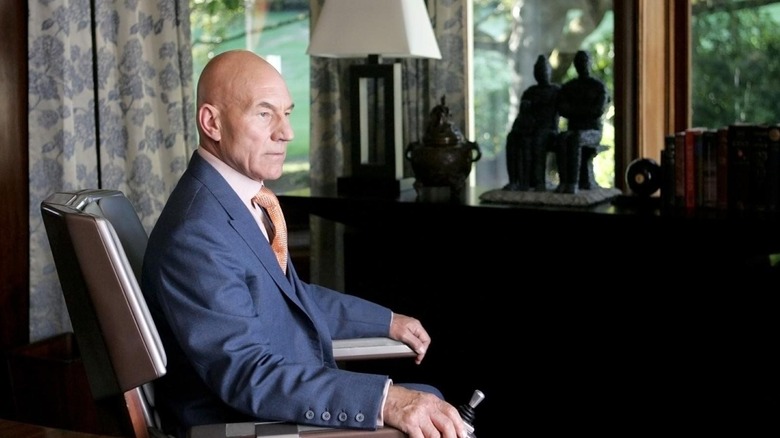
After a successful seven-year run on “Star Trek: The Next Generation,” Patrick Stewart became a recognizable pop culture figure, and was a shoo-in for the role of Prof. Charles Xavier in Bryan Singer’s “X-Men,” a film about superpowered mutants who develop powers at a young age, but are pilloried by society as a result. Charles Xavier, a stern and bald character, already resembled Stewart, so his casting felt natural. Stewart would play the role in multiple films — and in multiple timelines — over the next couple of decades.
Stewart appeared in multiple high-profile Hollywood productions besides. In 1997, he played the villain in Roger Christian’s “Die Hard”-in-a-high-school riff “Masterminds.” In a 2016 interview with Mandatory, Stewart said he assumed “Masterminds” was going to be the biggest hit of all time, making he and the others involved “richer than Croesus.” It was not to be. Stewart also played a villain in “Conspiracy Theory,” a catty “elder gay” in “Jeffrey,” and a vicious neo-Nazi in “Green Room.”
In film, Stewart’s voice was heard more often than his face was seen. He gave notable voice performances in such films as “The Prince of Egypt” and “Chicken Little,” and in the English-language dubs of “Steamboy” and “Nausicaä of the Valley of the Wind.” He also appeared in “The Emoji Movie” as the voice of the poop emoji. Stewart actually provided the opening narration for “The Nightmare Before Christmas,” but his vocals were not used in the final cut of the film, making their way onto the movie’s soundtrack record instead. On TV, he voiced roles on “Futurama,” and “Robot Chicken.” He worked for Seth MacFarlane on “Family Guy,” “American Dad,” and “A Million Ways to Die in the West.”
Clearly, after the “Next Generation” incident, Stewart happily embraced his sillier side.
Fighting abuse, loving pit bulls
Paramount
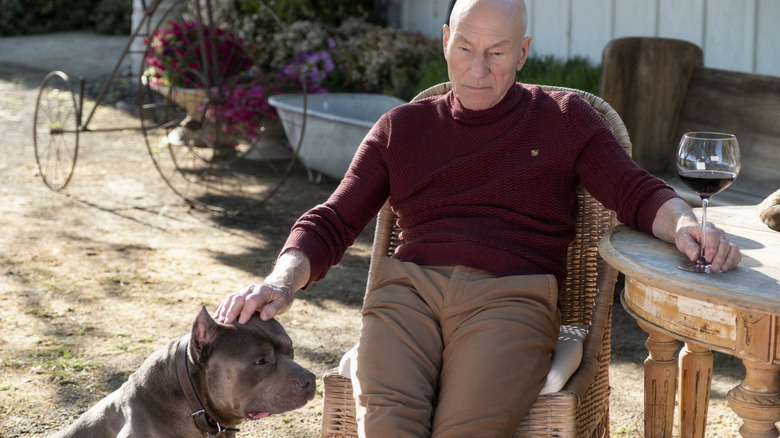
Patrick Stewart worked with various charities throughout his career, raising money for that causes he believed in. One might notice that, in the first season of “Star Trek: Picard,” Stewart is seen piling attention on his pet pit bull, Number One. In real life, Stewart was very fond of pit bulls, and worked with the ASPCA on efforts to stop dog fighting and protect the animals. Additionally, he contributed to charities that support sufferers of combat-related PTSD, and fought to end domestic violence. As recently as 2019, Stewart chaired the International Rescue Committee, a committee to help refugees. Stewart was an atheist, and contributed to the British group Humanists UK.
Stewart was knighted in 2010.
As an actor, Stewart always took his craft incredibly seriously, even as he loosened up. He studied the characters, the readings, and the dramaturgy of his part. He had a unique talent of making even the strangest, most alien, or most ancient dialogue feel natural and poetic. He was a man so devoted to his craft that other performers could only aspire to match him. It might be said that Stewart’s presence on “Star Trek: The Next Generation” is what elevated the series to its celebrated status. It was his attitudes that allowed the show — and the franchise at large — to steer itself toward adult diplomacy over cowboy frontiersmanship.
On screen, on stage, and in life, Stewart was the professor you didn’t want to disappoint. An intelligent, dignified, and devoted man, he was an aspirational figure. As he aged, Stewart became more and more relaxed, certainly became more whimsical, and he could be seen smiling more and more in pictures. The man spent his life pursuing the art he loved, was quite the expert in it, and aged into the happiest version of himself.
Rest in peace, Sir Patrick Stewart.

Upgrade Your Movie Nights with Fire TV Stick 4K Plus
Stream movies, shows and entertainment in 4K with an easy upgrade for your TV.
View on Amazon