
Orion Pictures
We may receive a commission on purchases made from links.
Video games are having a movie adaptation moment. For the last couple decades, superhero adaptations were all the rage. But films based on books are still big business in Hollywood. Studios are seeing major success adapting the latest BookTok crazes, as evidenced by the likes of Lili Reinhart’s rom-com “The Love Hypothesis” becoming a Prime Video mega-hit. Meanwhile, Denis Villeneuve has triumphed where many have failed by adapting the supposedly unfilmable “Dune” into a successful blockbuster franchise. Books have been a reliable source of inspiration for filmmakers for decades, and that shows no signs of changing.
We don’t typically associate the uber-macho action heroes of the 1980s with a literary heritage, but perhaps we should. So many of these action icons actually started out in the pages of thriller novels, with Hollywood finding repeated success by adapting both popular and lesser-known stories into bombastic big screen blockbusters.
In some cases, these films’ literary origins are well-known. Today, for example, audiences are aware that “The Running Man” started life as a Stephen King story, and the same is true of “The Shining” — though this may just be the King effect. The box office flop that was David Lynch’s “Dune” was always widely known to be an adaptation of Frank Herbert’s seminal sci-fi tome, even if the author likely wished otherwise. But it’s probably not as well-known that “Die Hard” was based on a book, or that John J. Rambo started out as author David Morrell’s attempt to explore the lingering effects of the Vietnam War on veterans. With that in mind, we’ve rounded up five ’80s action movies that most fans likely didn’t know were based on books.
Die Hard (Roderick Thorp’s Nothing Lasts Forever)

20th Century Studios
John McTiernan’s “Die Hard” might be the most important action movie of the 20th century. Not only did it match fellow ’80s actioners in terms of popularity and cultural impact, but Bruce Willis’ everyman hero allowed an entire generation to imagine that they, too, might just be able thwart the plans of a terrorist organization should they find themselves trapped in a besieged tower block. It represented an evolution of the action genre that has birthed a million “Die Hard” clones in the decades since its launch — a trend that’s very much still alive today. But what many might not know is that “Die Hard” itself was a copy of an earlier story: Roderick Thorp’s “Nothing Lasts Forever.”
If you compare “Die Hard” to “Nothing Lasts Forever,” you’ll find that screenwriters Jeb Stuart and Steven E. de Souza didn’t actually change too much about the basic premise when they came to adapt the novel for the big screen. The 1979 book, a sequel to Thorpe’s 1966 novel “The Detective,” follows NYPD detective Joseph Leland, who visits Los Angeles to reconcile with his estranged daughter, only to find himself battling European terrorists after they descend on the skyscraper where his daughter works. But there’s far more reflection and regret in the novel, which sees Leland reckoning with a life spent falling short as a husband and father and rehashing his experiences as a soldier in World War II.
The book received a negative review from the New York Times, with writer Newgate Callendar calling it “poorly organized” and “filled with stilted dialogue and the inevitable infuriating flashbacks at moments of high action.” The book did receive more positive reviews elsewhere, however, and will ultimately be forever remembered thanks to “Die Hard.”
First Blood (David Morrell’s First Blood)
Orion Pictures
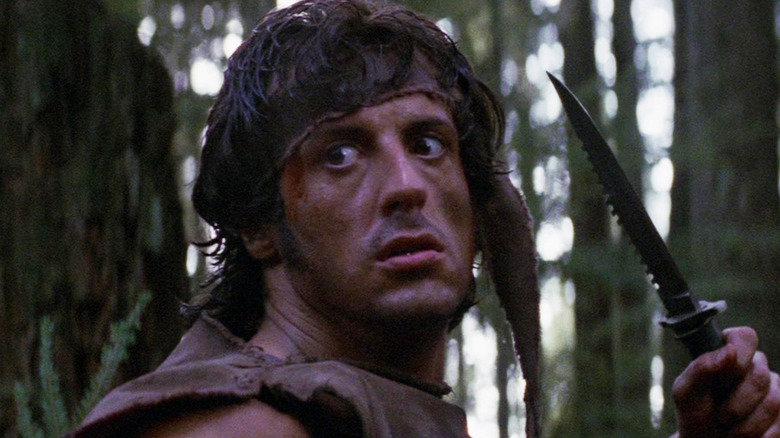
Ted Kotcheff’s “First Blood” is a foundational text of the 1980s action canon, and it’s sort of hard to believe that the killing machine known as John J. Rambo essentially debuted as a pacifist who only reluctantly engages his enemies. It was Sylvester Stallone that ensured Rambo refrained from intentionally killing anyone in “First Blood” as part of an attempt to make the character more likable. That oft-overlooked aspect of the character certainly doesn’t come from David Morrell’s 1972 novel, on which the film was based — though, considering the book was interested in probing the lingering effects of the Vietnam War on its tortured veterans, it probably should have.
Whereas the events of the film play out in rural Washington, “First Blood” the novel follows a homeless veteran known only as Rambo as he arrives in the town of Madison, Kentucky. He’s picked up by a local sheriff who drops him off outside town. But after Rambo returns, he’s eventually locked up in a jail that conjures flashbacks of his time in a Viet Cong prison. So far, then, the story is basically the same as the film. But things change when, in the novel, Rambo escapes and holes up in the nearby mountains. He then kills multiple men who come after him before ultimately being taken down by the sheriff and his former special forces colonel. Of course, in the film Rambo lives to fight another day — and by “fight,” I mean “take out entire armies single-handedly.”
Interestingly enough, it was the violence in the book version of “First Blood” that drew the most criticism, with John Skow of Time going so far as to call the novel “carnography” — a fitting label for what the “Rambo” movie franchise eventually came to be.
Cobra (Paula Gosling’s A Running Duck/Fair Game)

Warner Bros.
After starring in one of the finest action films of the 1980s with “First Blood,” Sylvester Stallone tried his luck with another book adaptation. “Cobra” was loosely based on Paula Gosling’s 1974 novel “A Running Duck” (which was later published as “Fair Game”), with Stallone combining elements of Gosling’s story with a script he’d written for an installment of the “Beverly Hills Cop” franchise. He also starred as the titular Los Angeles police lieutenant, Marion “Cobra” Cobretti, who sets out to investigate a series of crimes while protecting a model with a target on her back. But the premise doesn’t really matter, because “Cobra” was simply an excuse for Stallone to hand out beatdowns to anyone who dared to look at him sideways.
As you might have guessed, since the book doesn’t star Sylvester Stallone, it’s much less bombastic. “A Running Duck” follows Clare, a copywriter who narrowly avoids a sniper’s bullet, after which Vietnam veteran and former sniper Lieutenant Mike Malchek is assigned to protect her while hunting down the shooter. Besides the basic idea of a tough dude protecting a woman targeted for assassination, however, there’s very little of Gosling’s book in “Cobra.” For example, unlike the movie, which features a deranged serial killer and cult leader known as the Night Slasher (Brian Thompson) as its villain, the book’s antagonist is a calculated professional hitman.
Stallone regrets “Cobra” despite its cult classic status, and it’s not hard to see why he might have mixed feelings about its unapologetically campy tone and embrace of police violence. Meanwhile, Gosling’s book was eventually given a more faithful adaptation in 1995 in the Cindy Crawford vehicle “Fair Game.”
Blade Runner (Philip K. Dick’s Do Androids Dream of Electric Sheep?)

Warner Bros.
The journey from book to screen for “Blade Runner” technically started with Martin Scorsese, who was initially interested in adapting Philip K. Dick’s 1968 novel “Do Androids Dream of Electric Sheep?” before abandoning the idea. Director Ridley Scott and writers Hampton Fancher and David Peoples eventually brought such an adaptation to fruition. But “Blade Runner” was not particularly faithful to the book.
That’s for good reason. Scott and his writers did what they needed to do in order to make the story work on the big screen, and considering “Blade Runner” is widely considered one of the most influential sci-fi movies ever made, it seems they made the right decision. That’s not to say they diverged from the source material as drastically as, say, Sly Stallone with his “A Running Duck” adaptation, though.
The novel follows a bounty hunter in pursuit of escaped androids in post-apocalyptic San Francisco. “Blade Runner” borrows the basic premise and Dick’s exploration of what it means to be human, but switches the location to Los Angeles and makes changes to the original plot. Dick’s plot, for instance, features a secondary storyline about a man who gives the androids shelter. The movie, however, keeps things focused on Harrison Ford’s Rick Deckard throughout. What’s more, its techno industrial nightmare-scape L.A. is significantly different from the scorched San Francisco of “Do Androids Dream of Electric Sheep?” The film also jettisons a religion known as Mercerism, which formed a big part of the world realized in Dick’s novel.
While many film adaptations have deviated from the source material at their peril, “Blade Runner” is a rare example of a film that makes major changes to the book on which it’s based with excellent results.
Conan The Barbarian (various stories by Robert E. Howard)

Universal Pictures
Many people known Conan the Barbarian thanks to the 1982 film directed by John Milius and starring Arnold Schwarzenegger. But this sword-and-sorcery legend emerged all the way back in the 1930s, when pulp writer Robert E. Howard introduced him in “Weird Tales.”
The film isn’t based on any one of those tales, and changes much about Howard’s original vision, giving Conan a backstory that involves his people being slaughtered by raiders, thereby propelling his quest for vengeance as an adult. Howard’s stories, however, depicted him as a formidable “Cimmerian” who simply adventures through the fictional Hyborian Age, taking on assorted eldritch beasts.
In “Flights of Fancy: The Great Fantasy Films,” author Kenneth Von Gunden notes how diehard Conan fans “were less than enthusiastic about Milius’ Conan,” and how Robert Garcia took the film to task in an issue of “American Fantasy” #2. “This Conan is less powerful, less talkative, and less educated than Howard’s,” wrote Garcia. “And therein lies the betrayal to the fans.” But it was hardly seen that way by the general public, who, if it weren’t for Schwarzenegger’s version of the character, likely wouldn’t know much at all about Howard’s creation at all. Today, “Conan the Barbarian” is a fantasy classic that’s just waiting to be rediscovered on Netflix.

Upgrade Your Movie Nights with Fire TV Stick 4K Plus
Stream movies, shows and entertainment in 4K with an easy upgrade for your TV.
View on Amazon